


Following the publication of Notice No. 713/Ric. of October 29, 2010 — Title III — Creation of New Districts and/or New Public-Private Partnerships, Europea Microfusioni Aerospaziali spearheaded the establishment of a public-private laboratory, which was subsequently formed in 2013 through a network agreement and named RITAM — “Research and Application of Advanced Technologies for Engines,” in order to develop scientific and technological topics of interest regarding lost-wax microfusions.
RITAM is a network of companies focused on promoting coordinated research and development activities in the field of innovative materials and advanced technologies for engines and engine components intended primarily for the aerospace sector and power generation.
The project that EMA carried out as the lead partner, code PON03PE_00111_1, is MATEMI – High-Efficiency Materials and Process Technologies for Innovative Microcastings, and was carried out in collaboration with the following project partners:
University of Naples Federico II – Departments of DII and DIETI
University of Salerno, Department of DII
University of Sannio, Department of DII
CRdC Tecnologie Scarl
Mosaico Monitoraggio Integrato s.r.l.
Tecnologica s.r.l.
PROMETE Srl
The network of companies also includes C.M.D. (Costruzioni Motori Diesel, part of the Chinese Longin Group) and C.I.R.A. (Italian Center for Aerospace Research) in Capua.
This Industrial Research (RI) and Experimental Development (RI+SS) project also includes a funded training program (FO) organized by EMA in accordance with the procedures set forth in the Call for Proposals.
Project start date: October 10, 2013
Project end date: December 31, 2018
Total project costs for PON03PE_00111_1, as per Decree No. 782 dated March 6, 2014.
IR € 4,859,761.58
SS: €4,373,355.41
FO: €783,672.00
For the beneficiary EMA:
Total eligible expenditure for the RI/SS project (CUP: B48F12000650005) € 6,397,437.50
Total eligible expenditure for the FO project (CUP: B46D12000490007) € 783,672.00
Total funding for the Industrial Research project: €3,335,068.75
Total funding for the Training project: €783,672.00
Funding percentages for Industrial Research (RI), Social Solidarity (SS), and Training (FO) are 65%, 40%, and 100%, respectively, as this is a partnership project involving collaborative Industrial Research activities among the partners of the RITAM Network.
Data updated as of October 1, 2019
Information also available on the website www.ritam.it and for programming www.ponricerca.gov.it

Project Objectives and Key Achievements
Project PON03PE_00111_1MATEMI – High-Efficiency Materials and Process Technologies for Innovative Microcastings
The MATEMI research project has enabled the development of innovative, cutting-edge scientific and technological knowledge in the field of ALLOY MICROCASTING, with the goal of improving production processes and developing new services for EMA, thereby enhancing the production of increasingly high-performance aircraft turbine blades.
The applied solutions adopted not only constitute the scientific and technological assets of the partners but can also be utilized in related industrial and technological sectors (power generation, mechanical engineering, plastics and molding, high-value-added technical ceramics, biomedicine, and other sectors that use equivalent technologies).
Wax Molding
EMA tested the technological solutions developed by its scientific partners (development of wax blends, optimization of the molding process through numerical modeling, and production of prototype molds via DMLS), thereby assessing the applicability of the scientific partners’ developments in the foundry setting. In addition, it studied the qualitative and quantitative impacts of different wax blade machining processes, developing and adopting new machining methods.
Ceramic cores and shells, process control, and their behavior in foundries
EMA has conducted extensive research and experimental analysis on core forming processes, process control (primarily control of the slurry), and the behavior of ceramic products during foundry thermal cycles. The company has employed both direct field testing and activities aimed at numerically modeling the behavior of ceramic materials. This has resulted in a set of guidelines for ceramic material and process design, which now enables EMA to better design optimal compositions for cores and shells, as well as thermal processes.
Furthermore, one of the most significant outcomes of the entire research project was the development of patent 102016000124073 for the integrated system for the automatic correction of the viscosity of a ceramic slurry.
Superalloy blades with higher castability
The importance of assembly configurations in achieving blades with high metallurgical and dimensional performance has been confirmed, although the solidification process has a decisive influence; in such cases (as in the case study of single-crystal casting), the ability to appropriately adjust the piston’s descent speed is crucial.
Development of post-casting processes, finishing, and the use of lasers in foundry processes
R&D activities focused on optimizing heat treatments—which are critical for the component’s final metallurgical structure—chemical etching—which is essential for the inspectability of the blades—the finishing phase, and, finally, new laser-based repair and machining techniques.
With regard to heat treatments, particular attention was given to studying an alternative system to the alumina bars on which the blades are placed to prevent contamination (ceramic plates in the molds). Solubilization tests were conducted on a small CMSX-6 alloy aircraft blade.
With regard to chemical treatments, the optimal parameters were identified to achieve high metallurgical properties and improved surface inspectability of the grain structure in the Marm200+Hf alloy.
Work on surface finishing led to a change in the material-removal belts and the introduction of ad hoc process monitoring systems.
The application of laser technology for repair and welding yielded the following results: laser welding of C20123 is feasible, while the CM247LC alloy was found to be non-weldable.
Patent: A patent titled “Shell Viscosity Correction Device,” with UIBM application number 102016000124073, has been filed.
Project PON03PE_00111_1 – F-MATEMI – Training in High-Efficiency Materials and Process Technologies for Innovative Microcastings
The training program, conducted by EMA, was designed to develop two professional profiles: industrial researchers with specific expertise in the field of technological processes and innovative materials for engines, who possess both general knowledge and a strong product-specific focus. Seven students completed the entire course, and all were hired by EMA upon completion of the training program.
Information and Advertising
Throughout the course of the project activities, seminars, presentations, and scientific articles were produced, which served to disseminate the scientific work carried out in a distinctive and effective manner.
In particular, the RITAM Network has consistently participated in SMAU in Naples since its very first edition, with its own booth, which in recent years has been located within the institutional spaces of the Campania Region.
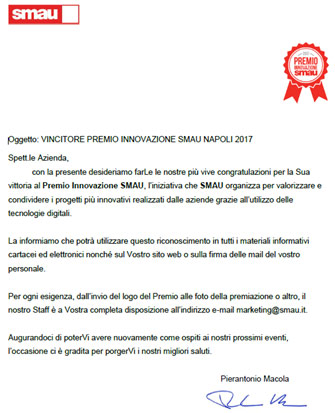
In 2017, EMA also won the SMAU Innovation Award.
Participation in conferences or seminars (C/S) and the publication (P) of articles in international journals are listed below.
P 2019: “Support Vector Representation Machine for superalloy investment casting optimization” C. Del Vecchio, G. Fenu, F. A. Pellegrino, M. Di Foggia, M. Quatrale, L. Benincasa, S. Iannuzzi, A. Acernese, P. Correra, L. Glielmo, *Applied Mathematical Modelling* 72 (2019) 324–336
P 2019: “3D Temperature Mapping of a Ceramic Shell Mold in the Investment Casting Process via Infrared Thermography,” C. S. Greco, G. Paolillo, M. Contino, C. Caramiello, M. Di Foggia, G. Cardone, Quantitative InfraRed Thermography Journal, https://doi.org/10.1080/17686733.2019.1608083, 2019
C/S 2017: Speaker on “Numerical Modeling and Experimental Characterization of Fused Silica-Based Ceramics During Investment Casting Processes,” University of Trento, CERMODEL 2017 – SESSION 5 – Trento, July 27, 2017;
B 2016: International patent PCT/IT2016/000029—Method for manufacturing silica cores for aircraft and industrial turbine components;
C/S 2016: Speaker on “Technology Challenges and Needs in the Investment Casting Foundry: Some Case Studies,” University of Burgos (Spain), Industrial Workshop and Standardization Innovation Toward Technology for the Extreme Conditions Industry, Burgos, October 5–7, 2016
C/S 2016: Speaker on “Development and Production of Molds Using SLM,” workshop on “Additive Laser Manufacturing of Metallic Materials,” 2nd edition, University of Salerno, September 29, 2016.
C/S 2016: Speaker on “Development and Production of Molds Using SLM,” Master’s Program in Additive Manufacturing, 1st edition, Rome, May 23–27, 2016, organized by CSM (RINA Group)
P 2016: “3D Temperature Map Reconstruction of a Ceramic Shell Mold in the Investment Casting Process,” https://www.ndt.net/search/docs.php3?showForm=off&id=20659, C.S. Greco, G. Paolillo, C. Caramiello, M. Di Foggia, and G. Cardone
P 2016: “Technical Feasibility of Laser Dissimilar Welding of Superalloys on Cast Nozzle Guide Vanes,” Procedia CIRP 41 (2016), pp. 963–968, 48th CIRP Conference on MANUFACTURING SYSTEMS – CIRP CMS 2015, F. Caiazzoa,*, V. Alfieria, V. Sergia, Andrea Tartagliab, M. Di Foggiab, A. Niolab